






Buying property in Spain as a foreigner: the complete 2026 guide

Buying property in Spain as a foreigner is completely legal and, for most people, simpler than they expect. There are no restrictions on nationality, you don’t need to be a resident and you can even sign the final deed from abroad. The tricky part is the details: a fragmented market with no central listing system, documents in Spanish, a tax bill that changes from one region to the next and a notary who checks far less than most buyers assume.
This guide walks you through the whole journey, from setting a budget to getting your keys, with the costs, the mortgage options, the mistakes we see most often and the areas worth a look in 2026. Each section links to a detailed article if you want to go deeper.
Budget the price plus around 10% for taxes and fees (more in regions with a high transfer tax, less where it’s low). Get your NIE early, have the property legally checked before you sign anything binding and expect to pay a 10% deposit at the arras stage. Buying a home does not give you residency: the golden visa for property investors ended on 3 April 2025.
Can a foreigner buy property in Spain?
Yes. EU and non-EU citizens can buy on exactly the same terms as Spaniards. Americans, Brits, Canadians, Swiss or Australians all buy freehold, in their own name, with the same rights as a local owner. We go into the details in can a foreigner buy a house in Spain.
Owning a home does not give you the right to live in Spain. The golden visa for property investors was abolished on 3 April 2025 (Ley Orgánica 1/2025), so buying a home no longer opens a residency route on its own. If you want to live here full time you’ll need a separate visa, such as the non-lucrative visa for retirees and people with passive income. See Spain ends the golden visa, can I live in Spain full time if I buy a property and our non-lucrative visa guide.
The buying process, step by step
Ten steps, from your first budget to your first year as an owner.
- 1
Set a realistic budget (price plus costs)
Start with the all-in number, not the asking price. On a resale home you pay transfer tax (ITP), which ranges from 6% to 13% in the regions most foreign buyers look at, depending on the region and the price, plus notary, land registry and legal checks. On a new build you pay 10% VAT plus stamp duty (AJD). Tinsa, the valuation firm, puts total purchase costs at roughly 10% of the price (April 2026). Our purchase tax simulator gives you a figure for your region in a couple of clicks and the full breakdown is in our pillar guide to property taxes and buying costs in Spain.
For a sense of prices, idealista’s September 2026 report puts the national average asking price at €2,930 per m², up 11.8% in a year. Our article on the average cost of a home in Spain breaks this down by region and if you’re coming from North America, price per m² in Spain vs the USA helps you compare.
- 2
Get your NIE
The NIE (Número de Identidad de Extranjero) is your Spanish tax identification number. You need it to sign the deed, pay taxes, open a bank account and connect utilities. It can be requested at a Spanish consulate in your home country or at a police station in Spain, or through someone holding your power of attorney. Appointment availability varies a lot, so start early: a missing NIE is one of the classic reasons a completion date slips. Everything you need to know is in our NIE guide.
- 3
Open a Spanish bank account
You don’t strictly need a Spanish account to buy, but you’ll want one to pay the deposit, receive the banker’s draft for the notary and set up direct debits for IBI, community fees and utilities. Non-resident accounts are available at most banks. Compare them in best banks in Spain for foreigners.
- 4
Search for the right property
Spain has no MLS. The same apartment can appear on five portals at five different prices, many listings are out of date and listing agents work for the seller. That’s why most buyers spend far more time filtering than they expect. If you’re comparing ways to buy, read real estate agent vs property hunter in Spain and buying alone, with a lawyer, an agent or a property hunter.
- 5
Make an offer and reserve
Prices in Spain are usually negotiable, especially on resale homes that have been listed for a while. Once your offer is accepted, the selling agency may ask for a small reservation deposit to take the property off the market. Don’t pay it before you know what you’re reserving: ask for the nota simple first and make sure the reservation document says what happens to your money if the legal checks reveal a problem.
- 6
Legal checks: nota simple, cadastre and planning
This is the step that protects you. The nota simple is an extract from the Land Registry showing who owns the property, its description and any mortgages, liens or seizures recorded against it. It should be compared with the cadastre (see what is a cadastral reference), because extensions, pools or extra rooms that exist on the ground but not on paper are common. On top of that, someone needs to check unpaid IBI, community fees, urban planning issues, the energy certificate and, for a flat, the community’s minutes for upcoming works.
- 7
Sign the arras contract
The contrato de arras is the private purchase agreement. You normally pay 10% of the price and agree on a completion date. Under the most common type (arras penitenciales), if you pull out you lose the deposit and if the seller pulls out they must pay you back double. Read it carefully, ideally in a bilingual version and only sign once the legal checks are done.
- 8
Complete at the notary
On completion day, buyer and seller (or their representatives with power of attorney) sign the escritura pública in front of a Spanish notary and the balance is paid, usually by banker’s draft or transfer. The notary checks identities, reads the deed and makes sure the formalities are respected, but does not investigate the property on your behalf. Our article on the role of the Spanish notary explains what the notary does and does not do.

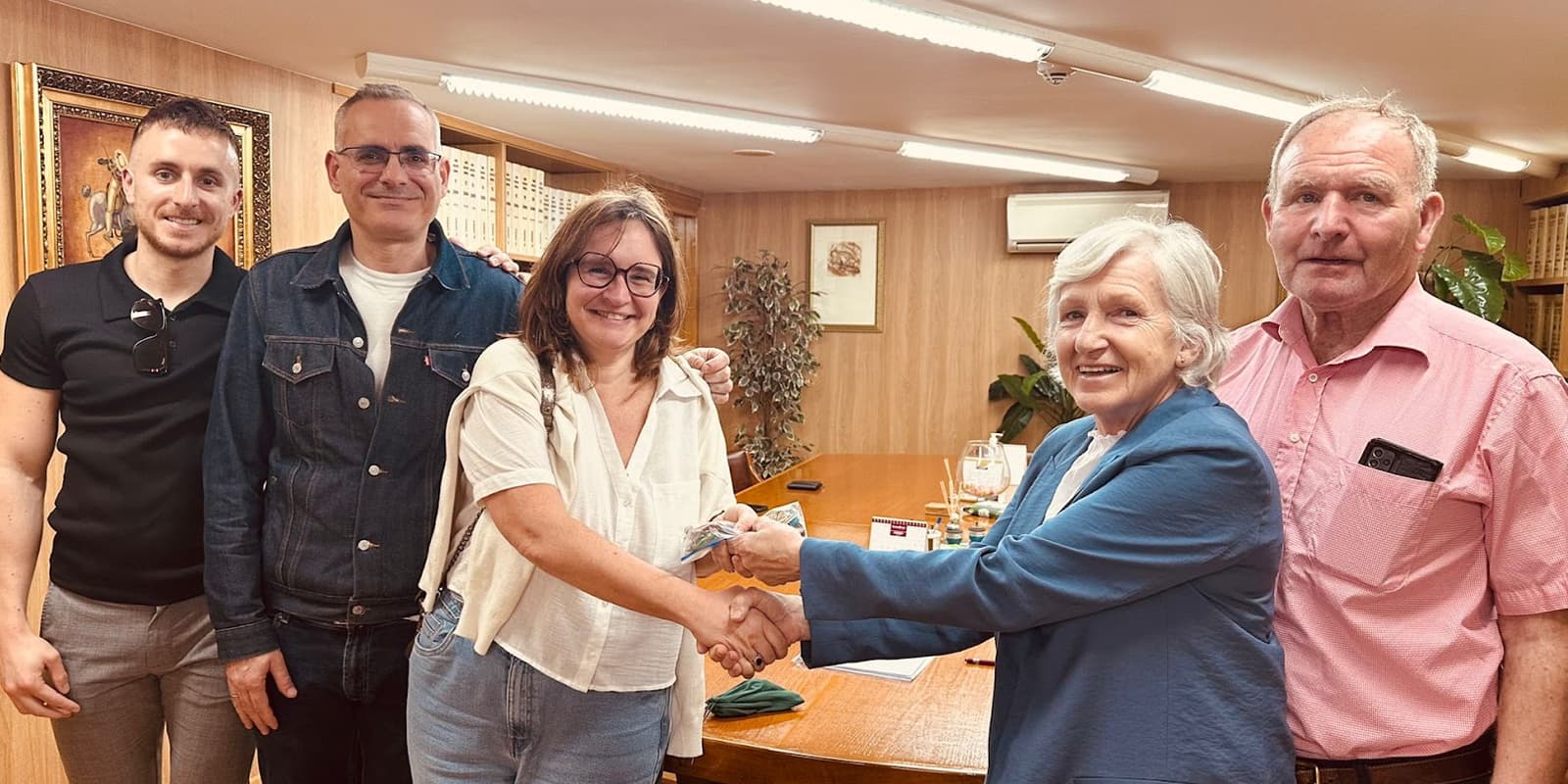
Signing day: the deed is signed in front of the notary, with the buyers and our team. - 9
Pay taxes and register the deed
After signing, the transfer tax (or VAT and AJD) is paid and the deed is presented to the Land Registry so your ownership is protected against third parties. If the seller is not a Spanish tax resident, you must withhold 3% of the price and pay it to the Tax Agency with form 211 within one month (Agencia Tributaria). Your legal adviser or gestor usually handles this.
- 10
After the purchase
You then change utilities into your name, set up direct debits and get ready for the yearly taxes: IBI to the town hall and, if you’re a non-resident, the non-resident income tax on the property. If you plan to rent the home out, check the rules first (see our guide to investing in Spanish property).

How much does it cost to buy? A quick overview
Here’s what to expect on top of the price. Rates below are the general rates for resale homes, as published by each region and summarised in October 2026.
| Cost | Typical amount |
|---|---|
| Transfer tax (ITP), resale homes | Andalusia 7%, Madrid 6%, Murcia 7.75%, Valencia region 9% (11% above €1M), Catalonia 10% to 13% by bracket, Balearics 8% to 13% |
| New builds | 10% VAT plus AJD stamp duty (for example 1.2% in Andalusia, 1.4% in the Valencia region, 1.5% in Catalonia) |
| Notary and Land Registry | Set by official fee scales; the registry usually charges €100 to €400 (Tinsa, April 2026) |
| Legal checks | Depends on who does them; our pricing page explains what’s included with us |
| Mortgage costs (if any) | Valuation and bank fees; the bank pays the mortgage stamp duty since 2018 |
For the full picture, including what changed in 2026 in the Valencia region, see taxes when purchasing a property in Spain and real estate taxes in Spain.
Want your exact budget? Our closing cost calculator works out ITP, notary fees and the rest from your price, your region and the type of property.
What would your budget buy?
Tell us what you’re looking for and we’ll get back to you with a first view of what your budget can buy. You get a realistic budget, taxes included, from the very first call.
Getting a mortgage in Spain as a foreigner
Spanish banks do lend to non-residents, but on stricter terms than to residents. Most cap the loan at around 60% to 70% of the purchase price or valuation, whichever is lower, so you’ll typically need 30% to 40% of the price plus costs in cash. Non-resident loans usually run up to 20 years, with some banks going to 30 (Rastreator).
For context, the average home mortgage signed in Spain in July 2026 was €180,785 over 26 years at an average rate of 3.01% and 62.3% of new loans were fixed rate (INE, September 2026). The 12-month Euribor, which variable loans follow, averaged 2.954% in August 2026 (Banco de España).
Go deeper with Spanish mortgages for foreigners, financing property in Spain and, for Americans, mortgage in Spain as a U.S. citizen.
Common pitfalls (and how to avoid them)
Surface areas, “sea views” and even the existence of a legal pool can be optimistic. Compare the listing, the nota simple and the cadastre.
Reservation money is often hard to recover. Get the legal picture first.
The notary authenticates the sale; due diligence is a separate job.
An illegal extension or pool can mean fines or costly legalisation later and it can complicate a mortgage.
IBI, community fees, non-resident income tax and insurance add up. Factor them into your budget.
Many towns and buildings now restrict holiday lets. Check before you buy, not after.
No NIE, no completion.
We’ve collected the mistakes we see most in the pitfalls of buying a property in Spain and mistakes to avoid when moving to Spain. And if you’re still deciding whether to go ahead at all, read is it worth buying a house in Spain and is it still a good idea to buy property in Spain.
Where to buy in Spain
Prices vary hugely. In September 2026, idealista’s asking prices ranged from €1,689 per m² in the Murcia region to €5,065 per m² in the Madrid region and €5,593 per m² in the Balearics. A few markets our clients often look at:


Valencia
The city reached this level in July 2026. Read our Valencia guide for expats.

Alicante and the Costa Blanca
Alicante city. Torrevieja €2,561, Jávea €4,166 and Dénia €3,354 per m².


Average asking prices per m², idealista, September 2026 (Valencia city: July 2026).
Murcia is one of the most affordable regions, with towns like Murcia and Cartagena. If the coast is the dream, read buying property in Spain by the sea. If budget is the main filter, see the cheapest areas in Spain to buy property. Coming from the US? Buying property in Spain vs the USA explains the main differences and buying a house in Spain gives another angle on the process.
Why use a buyer’s agent?
In Spain, the agent you meet at a viewing is almost always paid by the seller. A buyer’s agent, sometimes called a property hunter, works only for you. At SpainEasy, we search the whole market for you, visit properties on your behalf and with you, negotiate the price and accompany you all the way to the notary. Our in-house legal team runs the legal checks on the property before you commit.
You can see each stage in how we work. Our fees are published on the pricing page: the commission is only due once the property is secured at the arras signing and the start-up fee is refunded when you buy.
What our clients say
Real Google reviews from people who bought with us.
For the signing, I only travelled for the bank account opening and the notary, which saved me time and money.
Client of our sister brand Olé Immobilier. Translated from French.
So you can be sure that everything is done in the buyer’s interest and according to their criteria, with no nasty surprises.
Client of our sister brand Olé Immobilier. Translated from French.
They advised us perfectly, helping us avoid the pitfalls of buying in another country.
Client of our sister brand Olé Immobilier. Translated from French.
Talk to a buyer’s agent about your project
Ready to start? Tell us what you’re looking for and we’ll get back to you with a first view of what your budget can buy.
FAQ: buying property in Spain as a foreigner
Can a foreigner buy property in Spain?
Yes. Foreigners, whether from the EU or not, can buy property in Spain on the same terms as Spanish citizens and do not need to be resident. You will need an NIE (foreigner tax identification number) to complete the purchase.
How much are the costs of buying a house in Spain?
On top of the price, expect transfer tax (ITP) on a resale home, which in 2026 is 6% in Madrid, 7% in Andalusia, 7.75% in Murcia, 9% in the Valencia region and 10% to 13% in Catalonia, or 10% VAT plus stamp duty on a new build, plus notary, Land Registry and legal fees. Tinsa estimates total costs at roughly 10% of the price.
Do I need to be in Spain to buy a property?
No. You can give a power of attorney to a trusted representative who signs the arras contract and the deed at the notary on your behalf, so the whole purchase can be completed remotely.
Can I get a mortgage in Spain as a non-resident?
Yes. Spanish banks lend to non-residents, usually up to 60% to 70% of the purchase price or valuation, whichever is lower, so you need a larger deposit than a resident buyer.
Does buying a property in Spain give me residency?
No. The golden visa for property investors was abolished on 3 April 2025. To live in Spain you need a separate visa, such as the non-lucrative visa.